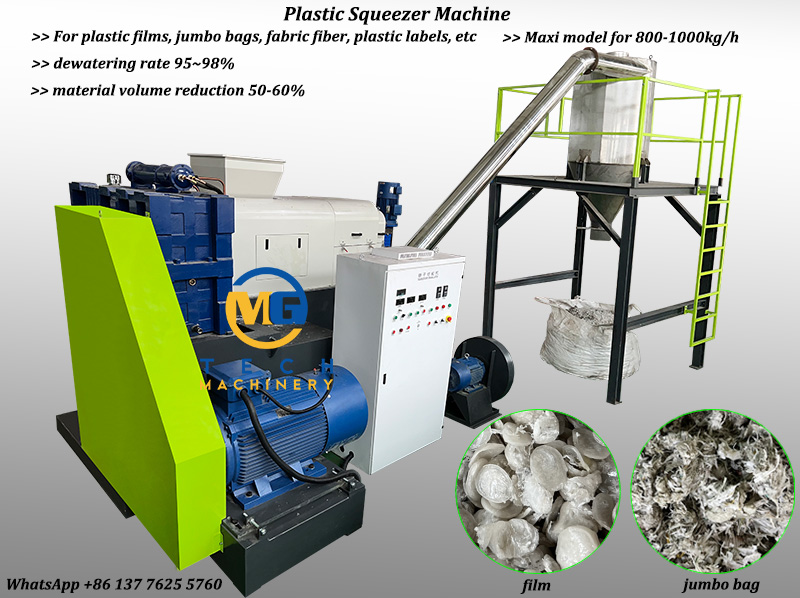
The recycling industry continues to evolve with advanced machinery designed to improve efficiency, reduce energy consumption, and increase material recovery. One of the most essential machines in plastic film recycling is the Plastic Squeezer Machine, specially developed for wet PE PP films and jumbo bag dewatering pelletizing processes.This innovative machine plays a critical role in removing moisture from washed plastic materials while simultaneously compressing and densifying them for easier pelletizing and recycling. It is widely used in recycling lines for PE film, PP woven bags, jumbo bags, agricultural films, shopping bags, and post-consumer plastic waste.Plastic Squeezer Machine for drying and agglomerating pelletizing waste plastic films and woven Bags, etc.The Plastic Squeezer Machine is an advanced industrial equipment designed for efficient drying and pelletizing of waste wet plastic films and woven bags. This squeezing machine is an essential solution for recycling facilities aiming to squeeze out moisture, reduce waste volume, save energy, and transform plastic waste into reusable agglomerated pellets for further manufacturing processes.

What Is a Plastic Squeezer Machine?

A Plastic Squeezer Machine is a specialized recycling machine designed to dewater and compact washed plastic films and soft plastics. After washing and rinsing, PE and PP films usually contain a high percentage of water, making drying difficult and costly. The squeezer machine efficiently removes moisture through mechanical squeezing and heating technology.The machine converts loose wet plastic flakes or films into semi-plasticized dense material, which can then be directly fed into pelletizing systems for granule production.

Applications of Plastic Squeezer Machine

Plastic squeezer machines are suitable for processing a wide range of soft plastic materials, including:

  • PE agricultural films
  • LDPE and LLDPE films
  • PP woven bags
  • PP jumbo bags
  • Stretch films
  • Plastic shopping bags
  • Packaging films
  • Industrial plastic scraps
  • Post-consumer plastic waste

These machines are commonly used in plastic recycling plants, waste management facilities, and pelletizing production lines.

Working Principle

The working process of a plastic squeezer machine is highly efficient and straightforward:

  1. Wet plastic films are fed into the machine after washing.
  2. The screw shaft compresses and squeezes the material continuously.
  3. Water is removed through drainage holes under high pressure.
  4. Frictional heat helps reduce remaining moisture.
  5. The machine discharges compacted and semi-dried plastic material.
  6. The output material is ready for pelletizing or further processing.

This process significantly improves drying efficiency while reducing energy costs compared to traditional drying methods.

Key Features of Plastic Squeezer Machine

High Dewatering Efficiency

The machine can reduce moisture content to as low as 3%–5%, making the material ideal for pelletizing.

Energy Saving Operation

Compared to hot air drying systems, plastic squeezer machines consume less power and provide better drying performance.

Strong Compression Capability

The machine effectively compresses loose plastic films into dense material, improving storage and transportation efficiency.

Continuous Automatic Operation

Modern plastic squeezer machines support continuous feeding and discharge, increasing productivity for recycling plants.

Durable Construction

Manufactured with high-quality steel and wear-resistant components, these machines are designed for long-term industrial use.

Suitable for Various Soft Plastics

The equipment can handle different PE and PP materials with stable performance.

Benefits of Using Plastic Squeezer Machines

Using a plastic squeezer machine offers multiple advantages for recycling businesses:

  • Reduces moisture content effectively
  • Improves pelletizing quality
  • Saves drying energy costs
  • Enhances recycling efficiency
  • Reduces labor requirements
  • Improves storage and handling of plastic waste
  • Supports environmentally friendly recycling operations

Importance in PE PP Film Recycling

Wet plastic films are difficult to process due to their lightweight structure and high moisture retention. Traditional drying methods often require large energy consumption and additional space.Plastic squeezer machines solve these challenges by combining squeezing, drying, and densifying functions into one compact system. This greatly improves the efficiency of PE PP film recycling lines and increases the value of recycled plastic materials.

Jumbo Bag Dewatering and Pelletizing

PP jumbo bags are widely used in industrial packaging and logistics. Recycling these bags requires proper washing and moisture removal before pellet production.Plastic squeezer machines efficiently process washed jumbo bag flakes and woven materials, producing dense semi-plasticized output that can be directly used in pelletizing extruders. This helps manufacturers produce high-quality recycled plastic pellets for reuse in various applications.

Choosing the Right Plastic Squeezer Machine

When selecting a plastic squeezer machine, consider the following factors:

  • Material type and thickness
  • Production capacity requirements
  • Moisture reduction performance
  • Machine durability
  • Power consumption
  • Automation level
  • Maintenance requirements

A high-quality machine ensures stable operation, lower operating costs, and better recycling output.

Conclusion

Plastic Squeezer Machines for wet PE PP films and jumbo bag dewatering pelletizing are essential equipment in modern plastic recycling systems. They provide efficient moisture removal, material densification, and energy-saving performance, helping recycling businesses improve productivity and sustainability.With increasing demand for plastic waste recycling and eco-friendly manufacturing, investing in advanced plastic squeezing and pelletizing technology is a smart solution for recycling plants worldwide.

A large productivity plastic pelletizing machine for WPC materials plays a critical role in transforming raw blends of wood powder, plastics (such as PE, PP, or PVC), and additives into uniform, high-quality pellets.

Plastic pelletizing machine for WPC is used to prepare 'ready to use' raw materials from wood powder, plastic hdpe or pp and processing additives for extrusion production of wood plastic composite wpc profiles. This type wpc plastic pelletizing machine has opening head design, the plasticized wpc materials are extruded out directly, and a cyclone system will cool the wpc materials and convey them into a crusher for processing into small particles.After Processed by the wpc granulation line, the compounded wpc materials can be used to produce kinds of wpc products, for example, WPC decking, wpc flooring, wpc doors, wpc boards, wpc door frame, wpc wall cladding, wpc moulding strips, wpc panels, wpc pallet, corrugated wpc roof tile, etc.In wood plastic composite WPC production, Especially for PE WPC and PP WPC, It is necessary to compound the materials well by the wpc pelletizing machine before end extrusion for good quality WPC profiles. With the special parallel twin screw designs of wpc pelletizing machine, the wpc materials can be exhausted well, and the different materials ingredients can be plasticized and mixed even. Therefore, It can ensure the final wpc profiles with uniform color and smooth section texture.FeaturesAdvantages of WPC plastic pelletizing machine in MG Machinery:1, good performance on plasticizing, exhausting and compounding. 2, screw is the building block model, all screw elements can be replaced easily. 3, screw elements is made from W6M05Cr4V2 steel, wearable, long lifetime.4, Barrel with alloy sleeve(A-101) for screw protection, hardness HRC58-64.5, cast copper type and cast aluminum heaters for even heating on the barrels.6, accurate temperature control by RKC or OMRON temperature meters.7, Main motor could be AC type with inverter, or DC type with speed regulator.8, High torque gearbox.9, streamlined feeder and hopper for smooth material feeding and easy cleaning.10, good lubricating oil cooling system and soft water circular cooling system.11, interlock control system for lubricator and host, feeder and host, pressure and host, current and host. For machine protection.

Key Features of Large Productivity Machines

1. High Output Capacity

Large-scale pelletizing machines can process hundreds to thousands of kilograms per hour, making them ideal for industrial production.

2. Twin-Screw Extrusion Technology

Parallel twin-screw designs provide:

  • Superior mixing and dispersion
  • Efficient degassing
  • Consistent pellet quality

3. Advanced Material Handling

  • Streamlined feeders and hoppers
  • Automated conveying systems
  • Easy cleaning and maintenance

4. Durable Construction

  • Wear-resistant screw elements (high-grade alloy steel)
  • Hardened barrels for extended lifespan
  • High-torque gearbox for stable operation

5. Precision Temperature Control

Modern systems use digital controllers (e.g., RKC/OMRON) for accurate heating, ensuring uniform melting and energy efficiency.

6. Efficient Cooling Systems

  • Water or air cooling systems
  • Lubrication and circulation systems to prevent overheating

Advantages of Large Productivity Pelletizing Machines

✔ Improved Product Quality

Uniform mixing ensures pellets with consistent color, density, and strength—essential for high-grade WPC products.

✔ High Efficiency & Automation

Automated feeding, extrusion, and pelletizing reduce labor costs and increase throughput.

✔ Cost Savings

Recycling and compounding reduce reliance on virgin materials, lowering production costs.

✔ Environmental Benefits

These machines support the circular economy by converting waste plastics and wood fibers into reusable materials.

Selection Considerations

When choosing a large productivity pelletizing machine, consider:

  • Material type (PE, PP, PVC with wood fiber)
  • Production capacity (kg/h)
  • Energy consumption efficiency
  • Pellet quality requirements
  • Automation level and maintenance needs

Conclusion

A large productivity plastic pelletizing machine for WPC materials is a cornerstone of modern composite manufacturing. By combining advanced extrusion technology, efficient compounding, and high automation, these machines deliver consistent, high-quality pellets at industrial scale.As industries move toward sustainable and cost-effective materials, investing in high-performance WPC pelletizing systems ensures greater productivity, better product quality, and long-term profitability.

In today’s world, plastic waste management has become a critical environmental and industrial challenge. The PE PP Plastic Film Washing Line from Machinemg offers a comprehensive and efficient solution for recycling polyethylene (PE) and polypropylene (PP) films. Designed with advanced automation and high-performance components, this system transforms contaminated plastic waste into clean, reusable raw materials.


What is a PE PP Plastic Film Washing Line?
A PE PP plastic film washing line is an integrated recycling system used to process waste plastic films such as packaging materials, agricultural films, and industrial plastic scraps. The system removes impurities like dirt, labels, and adhesives, restoring plastic films to a reusable state suitable for further processing.
This solution plays a vital role in promoting sustainable waste management and reducing dependence on virgin plastic materials.


Key Components of the Washing Line
The washing line consists of several interconnected machines, each performing a specific function in the recycling process:
1. Feeding System
A conveyor transports raw plastic waste into the system, ensuring a continuous and controlled workflow.
2. Shredder / Crusher
Plastic films are cut into smaller pieces to improve cleaning efficiency. Depending on material toughness, either or both machines may be used.
3. Friction Washing Machine
High-speed friction washers remove stubborn contaminants such as dirt and oil through mechanical scrubbing.
4. Rinsing Tanks
Water-based cleaning further purifies the plastic while separating heavier impurities through flotation techniques.
5. Drying System
Centrifugal dewatering machines or squeeze dryers remove excess moisture, preparing materials for downstream processing.
6. Control System
A centralized control cabinet monitors and regulates the entire process, ensuring stable and automated operation.
Working Process
The PE PP washing line follows a systematic process:
Feeding – Waste plastic films are loaded into the systemShredding/Crushing – Materials are reduced into smaller flakesWashing – Multi-stage cleaning removes contaminantsRinsing & Separation – Impurities are separated using water tanksDewatering/Drying – Moisture is removed efficientlyOutput – Clean plastic flakes ready for pelletizing or reuse
This streamlined workflow ensures high efficiency and consistent output quality.


Key Features and Advantages✅ High Efficiency & Automation
The system operates with advanced automation, reducing manual labor while increasing productivity.
✅ Strong Processing Capacity
Capable of handling large volumes of plastic waste, with output capacities ranging from 300 to 2000 kg/hour.
✅ Excellent Cleaning Performance
Multi-stage washing ensures thorough removal of contaminants, producing high-purity plastic flakes.
✅ Energy-Saving Design
Optimized systems reduce energy consumption, and some models support water recycling to minimize waste.
✅ Flexible & Customizable
The line can be tailored with optional equipment such as hot washers, label separators, and wastewater treatment systems.


Applications Across Industries
The PE PP plastic film washing line is widely used in multiple sectors:
Plastic Recycling Industry – Recycling films, woven bags, and packaging materialsPrinting & Packaging – Processing post-production plastic wasteAgriculture – Recycling greenhouse and mulch filmsManufacturing & Construction – Reusing plastic waste for new productsEnd Products and Uses
After processing, the cleaned plastic films can be:
Converted into plastic pellets for manufacturingUsed to produce new films, bags, and sheetsApplied in automotive parts, construction materials, and consumer goods
This not only reduces environmental pollution but also creates economic value from waste.


Conclusion
The PE PP Plastic Film Washing Line from Machinemg is a powerful and reliable solution for modern recycling needs. With its automated design, high processing capacity, and excellent cleaning performance, it enables businesses to turn plastic waste into valuable resources efficiently.

In today’s world, plastic recycling has become essential for reducing environmental pollution and conserving resources. A plastic granulator is a crucial machine in the recycling industry that converts plastic waste into small, reusable pieces. Industrial equipment from companies such as Machinemg helps manufacturers efficiently process plastic scrap and transform it into valuable raw material for new production cycles.

What Is a Plastic Granulator?

A plastic granulator is an industrial machine designed to crush and grind plastic waste into small granules or flakes. These granules can be reused in manufacturing processes such as extrusion, injection molding, or pelletizing. The machine uses high-speed rotating blades that cut plastic materials into smaller particles until they pass through a screen to achieve the desired size. Granulators are widely used in plastic recycling plants and manufacturing industries to process materials like bottles, films, pipes, sheets, and injection-molding scraps.

How a Plastic Granulator Works

The working principle of a plastic granulator is based on a rotor-blade cutting system:

  1. Feeding: Plastic waste such as PET bottles, plastic films, or defective molded products is fed into the hopper.
  2. Cutting Process: Inside the cutting chamber, a high-speed rotor equipped with sharp blades rotates and cuts the material against stationary blades.
  3. Size Reduction: The plastic pieces are repeatedly cut until they become small enough to pass through a mesh screen.
  4. Collection: The final plastic granules or flakes are collected for further processing or recycling.

This process significantly reduces the volume of plastic waste and prepares it for reuse in production.

Key Features of a High-Efficiency Plastic Granulator

Modern plastic granulators used in recycling systems offer several advanced features:

  • Heavy-duty steel construction for long-term industrial operation
  • High-speed rotor with precision blades for consistent crushing performance
  • Adjustable screen mesh to control granule size
  • Low noise and energy-efficient operation
  • Easy maintenance and blade replacement
  • Hydraulic hopper opening for convenient cleaning

These features ensure reliable performance, reduced downtime, and consistent granule quality.

Materials Processed by Plastic Granulators

Plastic granulator machines can process a wide range of materials, including:

  • PET bottles and containers
  • PP and PE plastic films
  • PVC pipes and profiles
  • HDPE and LDPE plastic scrap
  • Plastic sheets, bags, and woven materials
  • Injection molding runners and rejects

This versatility makes granulators an essential component of many plastic recycling lines.

Applications in the Recycling Industry

Plastic granulators are used in many sectors such as:

  • Plastic recycling plants
  • Injection molding factories
  • Packaging industries
  • Automotive plastic component recycling
  • Electronic waste processing

By converting plastic waste into reusable granules, these machines support circular manufacturing and reduce landfill waste.

Benefits of Using a Plastic Granulator

Using a high-efficiency plastic granulator offers several advantages:

  • Improves recycling efficiency by reducing plastic waste size
  • Lowers raw material costs through reuse of recycled plastics
  • Reduces environmental pollution from discarded plastic
  • Supports sustainable manufacturing practices
  • Produces uniform granules suitable for further processing

Conclusion

A plastic granulator is an indispensable machine in modern recycling systems. With its ability to efficiently crush and process plastic waste into reusable granules, it plays a key role in sustainable manufacturing. High-performance machines from Machinemg provide reliable, energy-efficient solutions for industries looking to improve recycling efficiency and reduce production costs while contributing to a greener environment.

Ready to upgrade your line? Check out options at machinemg.com to start your green shift today.

Every year, the world tosses out billions of plastic bottles. Most of them end up in landfills or oceans, harming wildlife and clogging up our planet. But PET plastic, the kind in those bottles, holds real promise for recycling. Raw PET flakes from crushed bottles often vary in size and cleanliness, making them tough to reuse directly. That's where a plastic PET pelletizing machine steps in. It turns those flakes into neat, uniform pellets called PET. These pellets mix easily into new products like bottles or fabrics. Among pelletizing tools, the strand pelletizer shines as the go-to choice for PET flakes recycling. It delivers high-quality results at scale, helping push forward a greener future.

Understanding the PET Recycling Process Chain

The journey from discarded PET to fresh material follows a clear path. Each step builds on the last to ensure top-notch output. A plastic PET pelletizing machine fits right in the middle, turning messy flakes into ready-to-use pellets.

Step 1: Initial PET Collection and Sorting

PET comes from places like water bottles, soda containers, and even strapping bands. Workers gather these items from curbside bins or deposit centers. Sorting happens next—by color, type, and label removal—to boost the purity. Without good sorting, contaminants sneak in and ruin later stages. Clean separation means better pellets down the line. For instance, clear PET stays with clear to keep colors pure.

Step 2: Washing, Drying, and Flaking PET Materials

Once sorted, PET items head to a wash line. Hot water and detergents scrub off labels, glue, and dirt. Then, a dryer removes moisture to prevent clumping. Finally, crushers or grinders break everything into small flakes, about 10-12 mm wide. This stage zaps out common foes like sand, oils, or food bits. Clean, dry flakes are key for smooth extrusion later. Think of it as prepping veggies before cooking—they need to be spotless for the best meal.

Step 3: The Role of Extrusion in Compounding and Degassing

Extrusion melts the flakes into a gooey flow. Here, the machine mixes in any needed additives, like stabilizers. Vacuum degassing pulls out trapped air, water, and bad smells. This step stops bubbles or weak spots in the final pellets. For food-safe rPET, it's a must—removes over 99% of volatiles. Poor degassing leads to yellowed or brittle pellets. The extruder acts like a chef kneading dough, ensuring even texture before shaping.

Core Components: The Plastic Pelletizing Machine System

A full plastic PET pelletizing machine setup handles tough PET flakes with ease. It blends power, precision, and smarts. The strand pelletizer method keeps things simple yet effective for recycling.

The High-Torque PET Extruder: Design for Difficult Inputs

PET flakes can be sticky or damp, so the extruder needs muscle. High-torque motors push through uneven loads without stalling. Screws with a 3:1 compression ratio mash and melt flakes gently. Heating zones ramp up from 240°C at the feed to 280°C at the die. This setup fights viscosity swings common in recycled PET. Robust gears last longer under constant strain. You get steady output, even from mixed flake batches.

Vacuum System Integration for Devolatilization

Moisture hides in flakes and boils during melt, causing defects. A strong vacuum pump links to the extruder barrel, sucking out vapors at 20-50 mbar. This devolatilization clears volatile organic compounds too. For high-end rPET, it meets strict FDA rules. Pumps like rotary vane types handle the load quietly. Without it, pellets might foam or lose strength. It's like venting steam from a pressure cooker—keeps everything safe and solid.

The Strand Pelletizer: Precision Cutting Technology

After extrusion, molten PET exits as thin strands through a die plate. A puller draws them into a water bath for quick cooling. Then, the strand pelletizer snips them into 3-4 mm cylinders with rotating blades. Blades spin at 1,000-2,000 RPM for clean cuts. Unlike underwater pelletizers, which suit sticky polymers, strand types work best for PET's clarity. Water baths avoid die clogs, a big win for steady runs. Picture a pasta maker—strands form, cool, then slice into bites.

Advantages of Strand Pelletizing for Recycled PET

Strand pelletizing beats other ways for PET flakes recycling. It offers reliability and quality in one package. Operators love its straightforward design for daily use.

Achieving Uniform Pellet Geometry and Consistency

Cylindrical pellets from strand cutters measure steady—say, 3 mm long by 2.5 mm wide. This shape feeds smoothly into molds or extruders later. No odd shapes mean less waste in downstream steps. Irregular bits from old grinders jam lines or vary melt flow. Uniform rPET boosts part strength by up to 10%. You save time and money on reworks. Even batches ensure your recycled bottles look as good as new ones.

High Throughput Capacity for Industrial Scale Recycling

Big plants process 500 kg per hour or more with these machines. That's millions of bottles turned yearly. Strand systems scale up without losing quality. Water cooling handles heat fast, keeping runs long. Compare to die-face cutters—they bog down with PET's buildup. High output fits the push for circular economy goals. In 2025, global PET recycling hit 3 million tons; tools like this drive that number higher.

Ease of Maintenance and Reduced Changeover Time

Blades in strand pelletizers swap out in under 30 minutes. No complex dives into water systems needed. PET's mild abrasion wears parts slow, so checks stay simple. Clean the bath daily to avoid slime. Switch colors? Just flush strands—no full teardown. Underwater setups take hours to drain and scrub. This cuts downtime by 40%, keeping profits up. Operators train quick, lowering skill barriers.

Critical Operational Parameters and Quality Control for rPET

Fine-tune your plastic PET pelletizing machine for peak results. Watch key settings to hit specs every run. Quality control catches issues early.

Optimal Barrel Temperature Profiles for PET Melting

Start feed zone at 220°C to soften flakes without burning. Build to 260°C mid-barrel for full melt. Die hits 270°C for smooth flow. Sensors track changes; adjust for ambient shifts. Too hot? Chains break, yellowing pellets. Too cool? Strands sag. Profiles vary by flake IV (intrinsic viscosity)—aim for 0.65-0.80 dl/g. Test melts often to dial it in.

Cooling Water Temperature and Strand Pull Speed Synchronization

Water at 15-20°C solidifies strands in seconds. Puller speed matches extruder output, around 10-20 m/min. Sync wrong, and you get wavy "fishtail" ends or sticky blobs. Use PLC controls for auto tweaks. Pellet length stays spot-on this way. Hot water risks remelt; cold slows production. Balance keeps efficiency at 95% or better.

  • Monitor speed with encoders for real-time fixes.
  • Check water flow—1-2 m³/hour per strand.
  • Dry pellets post-cut to under 0.02% moisture.

Post-Pelletizing Handling: Drying and Storage

After cutting, a centrifuge spins off water. Air dry if needed, especially for hygroscopic PET. Store in silos with dehumidifiers at 50% RH. Moisture creeps back fast, dropping quality. Bag in 25 kg units for easy ship. Final checks: melt flow index and color tests. Proper handling locks in rPET value for buyers.

Conclusion: Driving the Circular Economy with Advanced Pelletizing Solutions

A plastic PET pelletizing machine with strand pelletizer turns waste into wealth. It fits seamlessly in the recycling chain, from sorting to storage. Key parts like the extruder and vacuum system ensure clean, strong rPET. Benefits shine in uniform pellets, high speeds, and easy upkeep. Tune temps, speeds, and handling for top results. This tech fuels sustainable loops—recycle more, waste less.

High-efficiency pelletizing systems — such as those offered by MG Machinery — support both small-scale recyclers and large industrial operations by delivering energy-efficient, automated, and cost-effective processing lines.

The Zhangjiagang Good PP PE Film Plastic Pellet Making Machine — showcased on machinemg.com — is a high-performance plastic recycling solution designed for converting waste polypropylene (PP) and polyethylene (PE) films and bags into uniform plastic pellets. These recycled pellets can be re-used as raw material for manufacturing new plastic products, reducing plastic waste and supporting sustainable production practices.

What Is It and Why It Matters

Plastic film waste — such as packaging films, shopping bags, agricultural film, and industrial films — poses serious environmental challenges due to its volume and difficult degradability. Pelletizing this waste helps recover value from discarded plastics by turning them into reusable granules. The PP/PE pellet making machine from MG Machinery in Zhangjiagang, China, provides an efficient mechanical solution to this process.

ore Components and Operational Workflow

The machine is part of a Plastic pelletizing machine that typically includes:

  • Cutting Compactor: Cuts and compresses large films for easier feeding into the extruder.
  • Single or Double Screw Extruder: Melts and plasticizes the waste PP/PE material, with controlled degassing to eliminate moisture and air bubbles.
  • Hydraulic Screen Changer: Filters impurities from the melt to protect downstream components and enhance pellet quality.
  • Water-Ring Pelletizer or Strand Cutter: Converts molten plastic into pellets using a water cooling or strand-cutting method.
  • Dewatering & Cyclone Systems: Remove water from the pellets and transport them into storage.
  • Central Control Cabinet: Automates and monitors operation for efficiency and safety.

This workflow allows the machine to deliver consistent, high-quality pellets ready for reuse in extrusion, molding, or film production.

Key Features and Advantages

1. Broad Material Compatibility

The machine handles a wide range of waste films from PP and PE types — including LDPE, HDPE, LLDPE, and mixed film stocks — making it versatile for many recycling applications.2. Efficient Plasticizing and Degassing

Equipped with specialized screw and barrel designs (often made from treated alloy steels like 38CrMoAlA), the extruder offers strong plasticizing performance and effective removal of moisture and air, improving pellet integrity.3. High-Quality Components

Premium motors (e.g., Siemens or equivalent), robust reducers, ceramic heaters, precision temperature controls (often from brands like OMRON), and hydraulic screen changers contribute to stable, long-lasting operation.4. Modular and Automated Design

Hydraulic screen changes, integrated control systems, and optional automation reduce labor requirements, allow easier operation, and increase safety.5. Cost-Effective Recycling

By converting waste films into pellets suitable for re-use in producing bags, pipes, boards, and other plastic products, manufacturers can cut raw material costs and support circular economy goals.

Applications Across Industries

The PP/PE film pellet making machine serves multiple sectors:

  • Plastic Recycling Plants: Core equipment for processing film waste into reusable granules.
  • Manufacturing Facilities: Recycle in-house plastic scraps to reduce material purchasing costs.
  • Packaging and Agriculture: Reprocess film used in packaging and agricultural applications into pellets for other products.
  • Custom Plastic Production: Feed quality pellets into downstream processes like extrusion and injection molding.

Industrial Impact and Sustainability

With increasing regulatory and market pressures to reduce plastic waste, technologies like pelletizing lines provide a practical solution that drives recycling efforts and decreases reliance on virgin plastics. High-efficiency pelletizing systems — such as those offered by MG Machinery — support both small-scale recyclers and large industrial operations by delivering energy-efficient, automated, and cost-effective processing lines.

I BUILT MY SITE FOR FREE USING